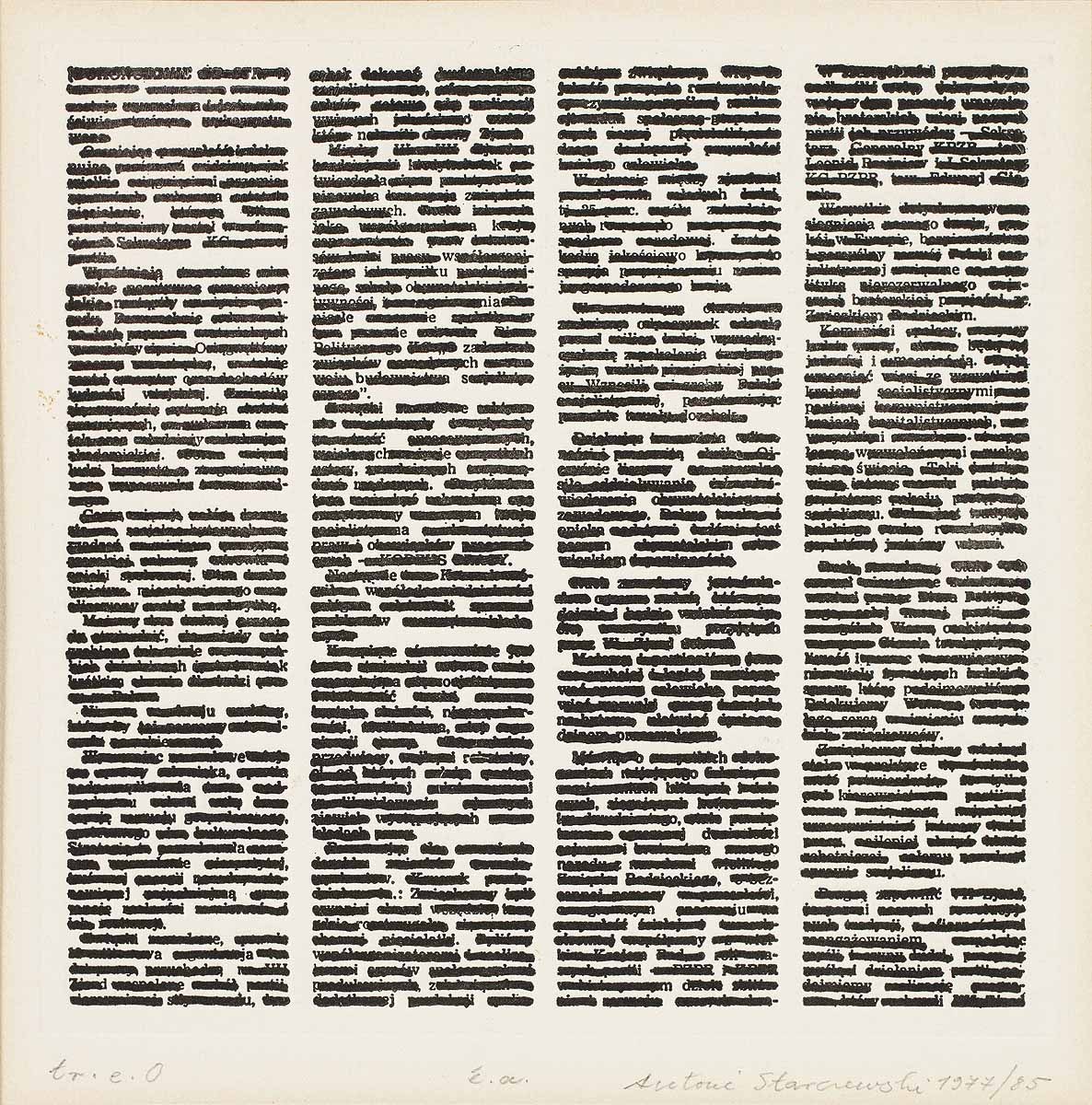
Dimensions: 23.7 x 23.7 (light frame), ed. EA
Signature: signed p.d.: Antoni Starczewski 1977/85, signed middleground: E.a., signed l.d.: tr. e. 0
Provenance
Poznan, private collection
Literature
Kowalewska M., Musiał G., Antoni Starczewski. Transpositions, published by the Central Museum of Textiles in Lodz, Lodz 2020, pp. 128 - 129.
Antoni Starczewski is primarily known for his sculptural activities, which he considered leading for a long time. At the end of the first half of the 1970s, graphic design became an essential part of his work. This medium fully satisfied his constant need to experiment and achieve results in a short period of time, allowing him to embody ideas almost immediately. Starczewski realized printmaking in the most varied printing techniques, often combining them with his own intervention. His work included the use of handwritten notes, linocut prints, collages using newspaper texts and waffle prints. It made the artist one of the most avant-garde Polish printmakers of the time. His works were noticed and appreciated not only in Poland but also in the world - including at the prestigious Tokyo Graphics Biennale in 1979.
Printmaking provided Starczewski with completely new opportunities in the field of interest in sign and writing. In the 1970s he studied graphology, deepening his knowledge of the relationship between the written sign and the psyche. In his works he used ready-made layouts of texts, such as excerpts from daily newspapers or books. The object of interest was not the content, but the layout of the reels and verses. Starczewski's own interference within them consisted of adding marks or deleting whole words, as in the case of the offered work. He did this with black or red ink, the line was thinner or thicker, revealing or completely blinding the word underneath.










